






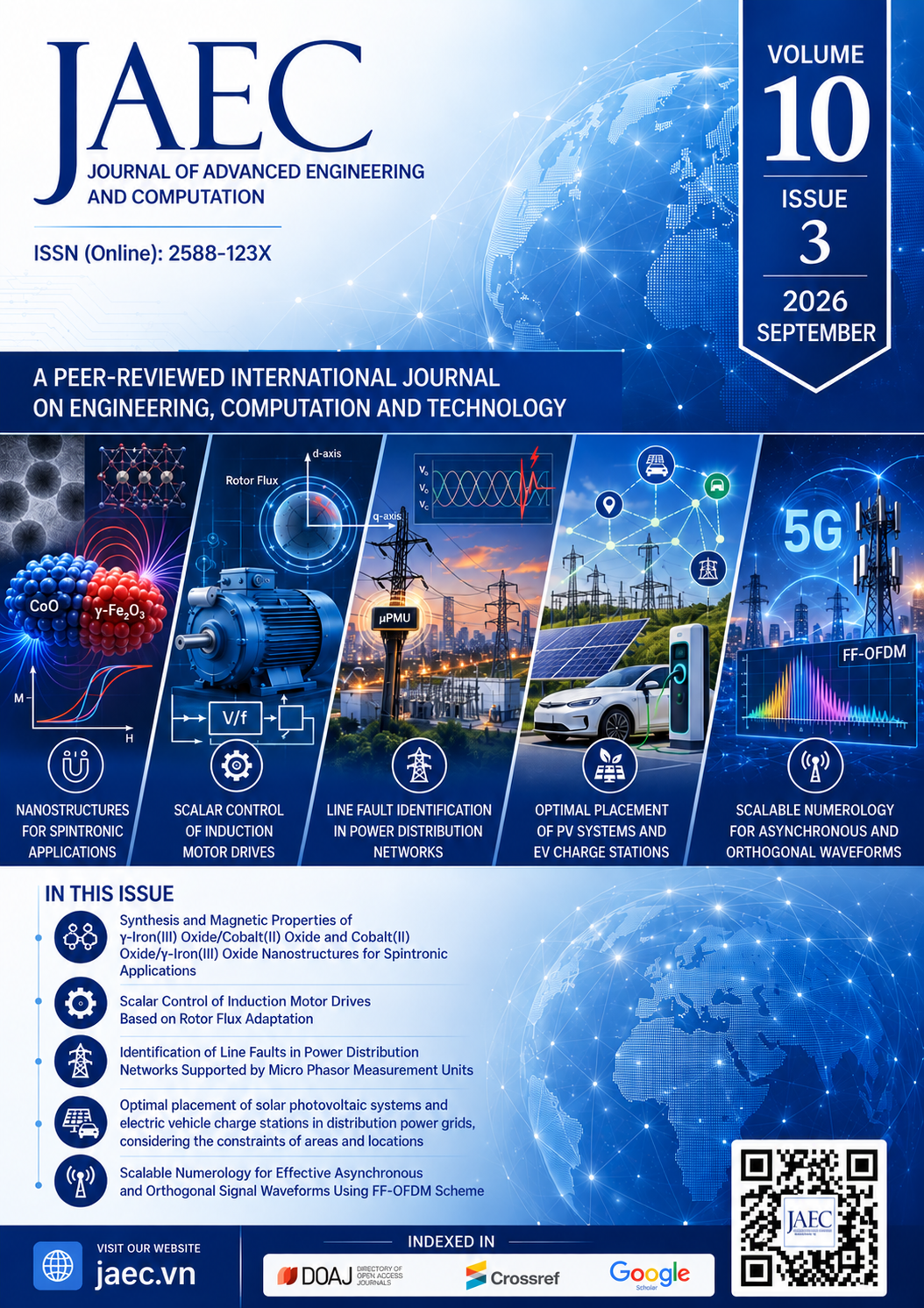







Issued quarterly (4 issues per year)

ISSN (Online): 2588-123X
ISSN (Print):
Researchgate Linkedin EmailFacebook Twitter
  • Home
  • Editorial Board
  • Guidelines
  • Policies
  • Submissions
  • Search
  • Archives
  • Announcements
  • Statistics

About TDTU

Ton Duc Thang University (TDTU) was established on September 24, 1997, as a public university under the Vietnam General Confederation of Labor. After 29 years of development, TDTU has grown into one of the leading universities in Vietnam, with a strong commitment to academic excellence, scientific research, innovation, and international cooperation. With modern facilities, advanced educational programs, and a multidisciplinary approach, TDTU provides a dynamic learning and research environment that promotes creativity and supports the comprehensive development of learners.

Currently, TDTU comprises 16 faculties and offers 52 undergraduate study programs, with a community of more than 77,000 alumni. The University also collaborates with more than 200 adjunct professors and researchers and has produced over 14,200 international publications, reflecting its growing contribution to global academic and scientific communities.

With the vision of becoming a world-class university, TDTU continues to strengthen its educational and research capacity, foster innovation, and enhance international collaboration. The establishment and development of the Journal of Advanced Engineering and Computation (JAEC) represent one of TDTU’s efforts to promote scientific research, disseminate advanced knowledge, and contribute to the development of engineering, technological and interdisciplinary research. More

Publication Information


Publisher
Ton Duc Thang University
Editor-in-Chief
Vo Hoang Duy
Executive Editor
Nguyen Trung Thang
Chairman of the Editorial Board
Vo Hoang Duy
Managing Editor
Nguyen-Thanh Nhon
Editorial Board
Fazel Mohammadi
Do Duc Ton
Partha Kayal
Vo Ngoc Dieu
Huynh Van Van
Dinh Hoang Bach
Timon Rabczuk
Hari Mohan Srivastava
Seung-Bok Choi
Carlo Cattani
Phan Thien Nhan
Nguyen Minh Tho
Adel M. Alimi
Petr Musílek
Jaroslav Pokorný
Juan Velasquez
Michal Wozniak
Hana Řezanková
Hendrik Richter
Mohammed Chadli
Nikolay V Kuznetsov
Shobhit K. Patel
Miroslav Vozňák
Roman Senkerik
Juan Carlos Burguillo Rial
Akhil Garg
Nguyen Pham Trung Hieu
Mahdi Shariati
Aleš Zamuda
Ngo Son Tung
Mai Ngoc Lan
User

Guide for Authors

  • View 'Guide for Authors' online

Submit Your Paper

In order to submit your paper, please login and navigate to the author page.

If you do not have an account, please consider registering one.

Track Your Paper

Track accepted paper
Once your article has been accepted you will receive an email from Author Services. This email contains a link to check the status of your articles.

Click here to track your accepted papers
Journal Content

Browse
  • By Issue
  • By Author
  • By Title

Abstracting/Indexing 

  • Home
  • Vol 3, No 4 (2019)
  • Velpula
Cover Image

Full-Color III-Nitride Nanowire Light-Emitting Diodes

Ravi Teja Velpula, Barsha Jain, Ha Quoc Thang Bui, Hieu Pham Trung Nguyen

Abstract


III-nitride nanowire-based light-emitting diodes (LEDs) have been intensively studied as promising candidates for future lighting technologies. Compared to conventional GaN-based planar LEDs, III-nitride nanowire LEDs exhibit numerous advantages including greatly reduced dislocation densities, polarization fields, and quantum-conned Stark effect due to the effective lateral stress relaxation, promising high-efficiency full-color LEDs. Beside these advantages, however, several issues have been identified as the limiting factors for further enhancing the nanowire LED quantum efficiency and light output power. Some of the most probable causes have been identified as due to the lack of carrier confinement in the active region, non-uniform carrier distribution, electron overflow, and the nonradiative recombination along the nanowire lateral surfaces. Moreover, the presence of large surface states and defects contribute significantly to the carrier loss in nanowire LEDs. Consequently, reported nanowire LEDs show relatively low output power. Recently, III-nitride core-shell nanowire LED structures have been reported as the most efficient nanowire white LEDs with a record-high output power which is more than 500 times stronger than that of nanowire white LEDs without using core-shell structure. In this context, we will review the current status, challenges, and approaches for the high-performance IIInitride nanowire LEDs. More specifically, we will describe the current methods for the fabrication of nanowire structures including top-down and bottom-up approaches, followed by characteristics of III-nitride nanowire LEDs. We will then discuss the carrier dynamics and loss mechanism in nanowire LEDs. The typical designs for the enhanced performance of III-nitride nanowire LEDs will be presented next. The color-tunable nanowire LEDs with emission wavelengths in the visible spectrum and phosphor-free nanowire white LEDs will be finally discussed.


Creative Commons License
This is an Open Access article distributed under the terms of the Creative Commons Attribution License (http://creativecommons.org/licenses/by/4.0/), which permits unrestricted use, distribution, and reproduction in any medium provided the original work is properly cited.


Full Text:

PDF

Time cited: 0

Download citation


DOI: http://dx.doi.org/10.25073/jaec.201934.271

Refbacks

  • There are currently no refbacks.


Copyright (c) 2019 Journal of Advanced Engineering and Computation


Owner: Ton Duc Thang University. All rights reserved.
License No: 507/GP-BTTTT, issued: 18th November 2016
Contact address: 19, Nguyen Huu Tho Street, Tan Hung Ward, Ho Chi Minh City
Tel: +84-28 3775 5037  Fax: +84-28 3775 5055
Editor-in-Chief: Dr. Vo Hoang Duy
Creative Commons License
This work is licensed under a Creative Commons Attribution 4.0 International License.