








Journal of Advanced Engineering and Computation
Research Impact
Since its establishment in 2017, the Journal of Advanced Engineering and Computation (JAEC) has consistently published high-quality, peer-reviewed research in engineering, computational sciences, artificial intelligence, and emerging technologies.
Published quarterly (four issues per year), JAEC has released more than 190 peer-reviewed articles, maintaining a regular publication schedule and rigorous editorial standards. Each issue presents a carefully selected collection of original research, ensuring scientific quality and long-term academic value.
Research published in JAEC has attracted about 1,600 Google Scholar citations, with an H-index of 20 and an i10-index of 36, demonstrating the journal's growing academic visibility and international scholarly influence. Google Scholar citation metrics are widely used to measure the visibility and impact of scholarly publications.
The journal publishes approximately 20 papers per year and receives more than 200 citations annually. Based on these figures, its estimated Impact Factor is greater than 10.
JAEC has demonstrated sustained citation growth in recent years. Since 2021, the journal has consistently received about 200 citations each year, reflecting the increasing recognition and use of its published research by the international scientific community. According to the current citation statistics for 2026, 213 citations have already been recorded, demonstrating the journal's continued citation momentum and growing academic impact.
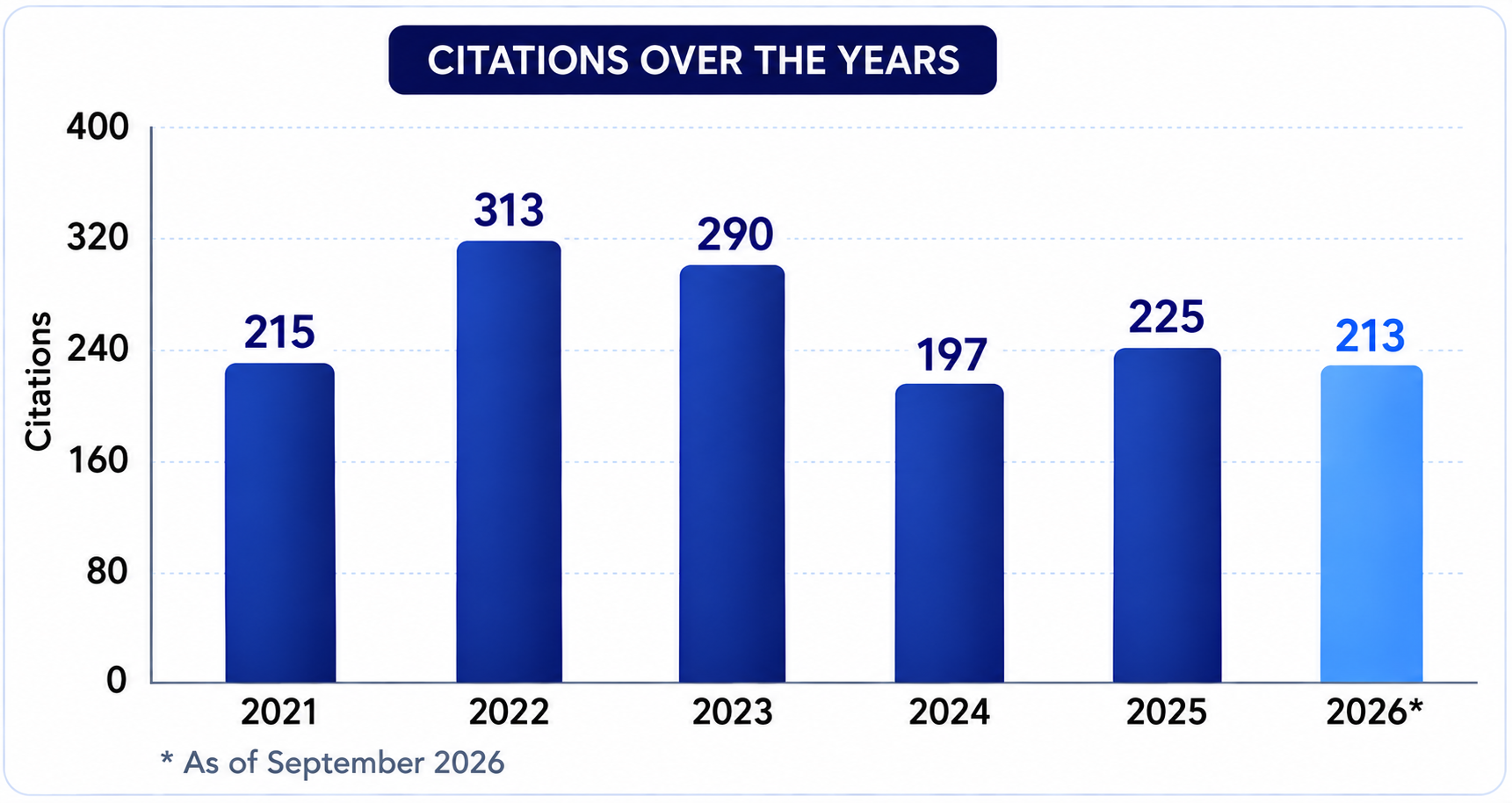
These achievements demonstrate JAEC's growing international visibility, the quality of its published research, and its increasing contribution to the global engineering and computational science community.
AIMS & SCOPE
Journal of Advanced Engineering and Computation (JAEC) provides an international platform for the dissemination of innovative theories, methodologies, applications, and research advances in the fields of intelligent systems, computational sciences, and modern engineering technologies. The journal encourages the exchange of scientific knowledge among researchers, academics, and industry professionals working in interdisciplinary areas related to artificial intelligence and advanced computation.
The journal welcomes high-quality contributions in, but not limited to, the following areas: Algorithms, Applicable Neural Networks Theory, Artificial Intelligence, Benchmarks, Fuzzy Logic, Applied Mathematics, Hardware Implementations, Hybrid Intelligent Systems, Intelligent Control Systems, Machine Learning, Deep Learning, Neural Networks, Neuro-Fuzzy Systems, Performance Measures, Software Simulations, Supervised and Unsupervised Learning Methods, and System Engineering and Integration.
JAEC also aims to promote research and technological developments in energy-related engineering fields, including Renewable Energies, Power Systems, Transmission Power Networks, Distribution Power Networks, Smart Grids, and Microgrids. The journal emphasizes interdisciplinary and international collaboration to support sustainable technological innovation and broaden the practical applicability of modern engineering and computational research.
READERSHIP
The journal provides a vehicle to help professionals, academics, researchers and policy makers working in fields relevant to advanced engineering and computation to disseminate information and to learn from each other's work.
CONTENTS
JAEC publishes original research papers, review papers, case reports, technical notes and short communications.
OPEN ACCESS
JAEC is a fully open access, single-blind peer reviewed, electronic and print, and a quarter-annual publication. Currently, Ton Duc Thang University is pleased to cover all publishing fees for the journal; as a result, authors do not have to pay any fees although their published papers are open to the reader.
TERM AND CONDITIONS
JAEC publishes Open Access articles under the terms of the Creative Commons Attribution License (http://creativecommons.org/licenses/by/4.0/), which permits use, distribution, and reproduction in any medium provided the original work is properly cited.
In this study, γ-Fe₂O₃/CoO and CoO/γ-Fe₂O₃ two-component nanoparticles were synthesized using a simple, two-step chemical process. Co(acac)₂ and Fe(acac)₃ were thermally decomposed in hot oleylamine, with mixed nucleation and the subsequent growth of the second component on seed nanoparticles forming the basis of the method. The resulting heterostructures were characterized by transmission electron microscopy (TEM), X-ray diffraction (XRD), and complementary techniques to confirm their composition, structure, and morphology. The nanoparticles exhibited high stability in nonpolar organic solvents due to an in-situ-formed organic coating. Magnetic measurements revealed that the antiferromagnetic CoO phase induces unidirectional anisotropy, arising from both magnetically compensated and uncompensated interfaces. This work demonstrates a facile approach to produce stable, core-shell cobalt-iron oxide nanoparticles with tunable magnetic interactions, suitable for applications in nanomagnetics and spintronic devices.
Power distribution systems are becoming more complex and vulnerable day by day due to the increasing penetration of non-linear loads, renewable sources, and critical expansions of the overhead supply networks. Thus, the chances of distribution line failures have increased. On this occasion, effective fault detection aids in developing predictive maintenance strategies, helping utilities reduce downtime and utilize resources more effectively. In this paper, a machine learning (ML)-based methodology for fault detection on overhead distribution lines has been presented. The study has demonstrated the application of the two typical tree-based ML classifiers, i.e., random forest (RF) and extreme gradient boosting (XGBoost), to diagnose distribution line faults with the help of a micro phasor measurement unit (μPMU) supported data set. The study reveals a μPMU allocation strategy and data collection method to aid in the preparation of the data set. The classification models are structured to classify the location of the line faults, followed by the faults' type, based on the prepared data set for a test network. The efficiency of the RF and XGBoost has been verified through a quantitative comparison with the existing approaches.
The increasing integration of photovoltaic (PV) generation and electric vehicle charging stations (EVCSs) into distribution power networks can significantly affect power losses and voltage performance, depending on their location and operating conditions. This study investigates the impacts of optimally installed PV units and EVCS location on the performance of a distribution power network. The Equilibrium Optimizer (EO) is employed to determine the optimal locations and rated powers of three PV units in the IEEE 33-node distribution network. The optimal PV units are located at Nodes 16, 25, and 31, resulting in a reduction in total active power loss from 0.211 MW in the base network to 0.090 MW, corresponding to a 57.3% reduction. Subsequently, an EVCS with a rated power of 1.080 MW is installed at three locations in turn: the end node (Node 33), the middle network (Node 6), and near the substation (Node 2). With the generation of PV units, the total active power losses are 0.175, 0.128, and 0.081 MW, respectively. In contrast, in the network without the generation of PV units, the losses increase to 0.425, 0.312, and 0.211 MW, respectively. The results demonstrate that EVCS location has a substantial influence on distribution network losses, with charging stations located farther from the substation producing greater impacts. Moreover, the generation of PV units effectively mitigates the adverse effects of EV charging by supplying power locally and improving voltage performance.
Wireless systems are often affected by distortions at the physical layer, which hinder reliable performance. A key challenge is the limited ability to suppress interference at the receiver, preventing the achievement of the asynchronous and orthogonal signal waveforms required for efficient utilization of Fifth Generation New Radio (5G NR) resources. Poor asynchronicity and orthogonality primarily result from Adjacent Channel Interference (ACI), Inter-Symbol Interference (ISI), and Inter-Channel Interference (ICI). This work addresses these challenges using the Feedback Filtered Orthogonal Frequency Division Multiplexing (FF-OFDM) channel access technique. Simulation results at 60 kHz Subcarrier Spacing (SCS) show that Hann--Kaiser-based FF-OFDM achieves superior mitigation of ICI (-47.0 dBm) and ISI (-39.0 dBm) compared to Hann-Chebyshev-based FF-OFDM (-45.2 dBm and -37.2 dBm, respectively). Conversely, Hann-Chebyshev-based FF-OFDM provides better ACI suppression (-27.5 dBm) than Hann-Kaiser-based FF-OFDM (-25.4 dBm). Similar trends were observed at 120 kHz SCS, where Hann-Kaiser-based FF-OFDM consistently produced more orthogonal signal waveforms, while Hann--Chebyshev-based FF-OFDM yielded safer asynchronous signal waveforms. The conventional and modified F-OFDM models were used as benchmarks for evaluating and validating these results.
This paper follows our previous research in which we made a basic experiment to find out if it is possible to detect malware by multiple PE header detection. The previous results show us that there is a considerable amount of malwares that connect themselves to another file. This paper summarizes our previous results, updates the results and also expands them by adding an optimization method and also by including the scan of another (specific) types of data.

This is an Open Access article distributed under the terms of the Creative Commons Attribution License (http://creativecommons.org/licenses/by/4.0/), which permits unrestricted use, distribution, and reproduction in any medium, provided the original work is properly cited.
Modal kinetic energy (MKE) feature has been mostly employed for optimal sensor layout strategies; nevertheless, little attention is paid to use the feature to the field of structural damage detection. The article presents the extensive applicability of MKE change ratio (MKECR), a good damage sensitive parameter, to damage localization and quantification of laminated composite beams. The formulation of the parameter is based on the closed-form of element MKE sensitivity. The performance of the offered damage detection method is numerically verified by a clamped-clamped composite beam and a two-span continuous composite beam with different hypothetical damage scenarios. The influence of incomplete mode shapes, various noise levels as well as damage magnitudes on damage prediction results are also investigated. The obtained results from these numerical examples indicate that the offered method reliably localize the actually damaged elements and approximately estimate their severities, even under incomplete measurements at a high noise level.
This is an Open Access article distributed under the terms of the Creative Commons Attribution License (http://creativecommons.org/licenses/by/4.0/), which permits unrestricted use, distribution, and reproduction in any medium provided the original work is properly cited.
Tax consulting service is one of various professional consulting services and is interested to study by many researchers. Nevertheless, this issue has not been interested to research in Vietnam. This paper performs confirmatory factors analysis (CFA) and structural equation modeling (SEM) to identify the factors influencing the intentions of using tax consulting services of firms in Ho Chi Minh city, Vietnam. Specifically, this paper finds that the intentions depend on the “attitude toward the behavior” and “replacement”. In addition, through Chi-square test, it can be proven that the intentions also depend on type of firms and whether they have ever used tax consulting service or not. Based on the obtained results, the discussion and recommendation are also proposed.
This is an Open Access article distributed under the terms of the Creative Commons Attribution License (http://creativecommons.org/licenses/by/4.0/), which permits unrestricted use, distribution, and reproduction in any medium, provided the original work is properly cited.
Comparing graph databases with traditional,e.g., relational databases, some important database features are often missing there. Particularly, a graph database schema including integrity constraints is mostly not explicitly defined, also a conceptual modelling is not used. It is hard to check a consistency of the graph database, because almost no integrity constraints are defined or only their very simple representatives can be specified. In the paper, we discuss these issues and present current possibilities and challenges in graph database modelling. We focus also on integrity constraints modelling and propose functional dependencies between entity types, which reminds modelling functional dependencies known from relational databases. We show a number of examples of often cited GDBMSs and their approach to database schemas and ICs specification. Also a conceptual level of a graph database design is considered. We propose a sufficient conceptual model based on a binary variant of the ER model and show its relationship to a graph database model, i.e. a mapping conceptual schemas to database schemas. An alternative based on the conceptual functions called attributes is presented.
This is an Open Access article distributed under the terms of the Creative Commons Attribution License (http://creativecommons.org/licenses/by/4.0/), which permits unrestricted use, distribution, and reproduction in any medium, provided the original work is properly cited.
In this paper, hidden bifurcation routes to multiscroll chaotic attractors generated by saturated function series are explored. The method to nd such hidden bifurcation routes (HBR) depending upon two parameters is similar to the method introduced by Menacer, et al. (2016) for Chua multiscroll attractors. These HBR are characterized by the maximal range extension (MARE) of their attractors and coding the appearance order of the scrolls under the control of the two parameters. Moreover, these HDR have interesting symmetries with respect to the two parameters. The novelty that this article introduces, is firstly the paradigm of MARE and the formula giving their approximate value depending upon parameters p and q, which is linked to the size of the scrolls; secondly the coding of the HBR which is dened for the first time including the basic cell; and thirdly unearthing the symmetries of these routes, allowing to obtain their coding without any numerical computation.
This is an Open Access article distributed under the terms of the Creative Commons Attribution License (http://creativecommons.org/licenses/by/4.0/), which permits unrestricted use, distribution, and reproduction in any medium provided the original work is properly cited.
III-nitride nanowire-based light-emitting diodes (LEDs) have been intensively studied as promising candidates for future lighting technologies. Compared to conventional GaN-based planar LEDs, III-nitride nanowire LEDs exhibit numerous advantages including greatly reduced dislocation densities, polarization fields, and quantum-conned Stark effect due to the effective lateral stress relaxation, promising high-efficiency full-color LEDs. Beside these advantages, however, several issues have been identified as the limiting factors for further enhancing the nanowire LED quantum efficiency and light output power. Some of the most probable causes have been identified as due to the lack of carrier confinement in the active region, non-uniform carrier distribution, electron overflow, and the nonradiative recombination along the nanowire lateral surfaces. Moreover, the presence of large surface states and defects contribute significantly to the carrier loss in nanowire LEDs. Consequently, reported nanowire LEDs show relatively low output power. Recently, III-nitride core-shell nanowire LED structures have been reported as the most efficient nanowire white LEDs with a record-high output power which is more than 500 times stronger than that of nanowire white LEDs without using core-shell structure. In this context, we will review the current status, challenges, and approaches for the high-performance IIInitride nanowire LEDs. More specifically, we will describe the current methods for the fabrication of nanowire structures including top-down and bottom-up approaches, followed by characteristics of III-nitride nanowire LEDs. We will then discuss the carrier dynamics and loss mechanism in nanowire LEDs. The typical designs for the enhanced performance of III-nitride nanowire LEDs will be presented next. The color-tunable nanowire LEDs with emission wavelengths in the visible spectrum and phosphor-free nanowire white LEDs will be finally discussed.
This is an Open Access article distributed under the terms of the Creative Commons Attribution License (http://creativecommons.org/licenses/by/4.0/), which permits unrestricted use, distribution, and reproduction in any medium provided the original work is properly cited.